
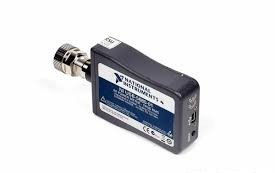

The NI USB-5680-01 RF Power Meter with True RMS is a compact instrument for precise RF power measurements across 50 MHz to 6 GHz. It employs True RMS detection to accurately characterize complex modulated signals and continuous wave sources, delivering ±0.18 dB amplitude accuracy with a 63 dB dynamic range. Onboard calibration constants—including linearity and temperature corrections—eliminate external calibration dependencies. USB 2.0 connectivity enables seamless integration into automated test systems and portable measurement setups.
– Technical Specifications
• Frequency Range: 50 MHz to 6 GHz
• Dynamic Range: 63 dB across two ranges: −40 dBm to −5 dBm and −5 dBm to +23 dBm
• Amplitude Accuracy: ±0.18 dB; ±0.13 dB at power levels below +18 dBm
• Linearity: Better than ±0.18 dB across all frequency ranges and power levels
• Input Return Loss: <−26 dB (50 MHz to <2 GHz); <−20 dB (2 GHz to 6 GHz)
• Measurement Speed: 15 measurements/second (Low-Aperture Mode); 1 measurement/second (High-Aperture Mode)
• Power Consumption: 100 mA typical; USB-powered
• Physical Dimensions: 8.5 × 3.0 × 5.6 cm; 6.4 oz
• Operating Temperature: 0 °C to 55 °C
• Connector: Type-N
– Key Features
• True RMS detection for accurate modulated and CW signal measurement
• Dual measurement ranges with independent aperture time control
• Configurable averaging to achieve noise floors as low as ±0.01 dB
• Hardware or software triggering for synchronized measurements
• Burst waveform and multislot waveform analysis (WiMAX, LTE, GSM, EDGE)
• Path loss measurement capability
• Mini-B USB 2.0 interface (12 Mbps); compatible with USB 1.1 and 2.0
– Typical Applications
• CW and average power measurement for RF transmitters
• Modulated signal characterization (3G, 4G, OFDM)
• Path loss assessment in RF systems
• Burst and multislot waveform analysis
– Compatibility & Integration
• Software APIs for LabVIEW, LabWindows/CVI, C, C++, and .NET
• NI-568x driver with soft front panel
• Windows Vista and Windows XP support
• Shock and vibration qualified per IEC 60068-2-1 and IEC 60068-2-2












Reviews
There are no reviews yet.