

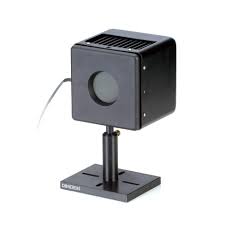
The Ophir 4010 is a laser power and energy meter engineered for precision measurement in alignment, optimization, and diagnostic applications. Built on Ophir’s smart sensor architecture, the 4010 accepts a broad range of interchangeable sensors—thermal, BeamTrack, pyroelectric (PE-C), and photodiode types—each carrying embedded calibration and identification data. This eliminates recalibration on sensor swap and enables true plug-and-play field operation.
– Technical Specifications
• Measures laser power and energy with full logging capability
• Records up to 250,000 non-volatile data points for trend analysis
• Acquisition rate: up to 10 kHz or 25 kHz depending on model configuration
• Power source: Rechargeable battery or AC mains operation
• Display: StarBright color TFT (320×240 pixels) or StarLite monochrome option
• Compact handheld form factor with rubberized bumpers (StarLite variant)
– Key Features
• Smart plug architecture stores sensor calibration internally—eliminates field recalibration
• Dual communication interfaces: USB and RS232 for data acquisition systems
• IEEE and Ethernet connectivity for networked deployments
• Large 320×240 color TFT display for field readability
• Supports ASCII command/response protocol for remote control operation (COM object recommended for optimal performance)
• User-friendly interface accommodates standalone or integrated measurement workflows
– Typical Applications
• Laser system alignment and beam characterization
• Power and energy trend tracking over extended periods
• Integration with LabVIEW-based test automation
• Multi-sensor field diagnostics without recalibration cycles
• Real-time pulse-by-pulse energy measurement at 10 kHz or 25 kHz rates
– Compatibility & Integration
The 4010 operates with over 150 Ophir sensor types, including thermal, BeamTrack, pyroelectric (PE-C only), and photodiode detectors. Front panel connections support RT and F connectors; rear panel includes RE connector with IEEE control option. LabVIEW integration and user-developed software interfaces are supported via documented ASCII protocol. Comprehensive user manuals and sensor performance datasheets are supplied with every instrument.


Reviews
There are no reviews yet.