

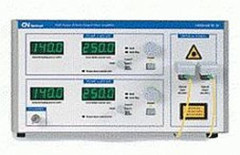
The Photonetics 3626 BTF Amplifier is an Erbium-Doped Fiber Amplifier (EDFA) engineered for high-performance optical signal amplification in the C-band telecommunications window. It delivers fixed-gain amplification independent of wavelength and input power, making it suitable for long-haul transmission, research applications, and optical test environments where signal integrity over extended distances is critical.
– Technical Specifications
• Wavelength Range: C-band, 1525–1560 nm
• Amplifier Type: Erbium-Doped Fiber Amplifier (EDFA)
• Small Signal Gain: Exceeds 35 dB at peak wavelength (1530 nm); 25 dB at 1550 nm
• Gain Flatness: Approximately 1 dB over 1530–1560 nm range; maintains flatness across 15 dB dynamic range
• Polarization Sensitivity of Gain: 0.5 dB (0.25 dB optional)
• Maximum Saturated Output Power: +17 dBm; variants available up to +20 dBm
• Noise Figure: 6 dB; variants offer lower values (4 dB typical in optimized configurations)
• Input/Output Isolation: 35 dB
• Dynamic Range: 15 dB
– Key Features
• Fixed-gain block architecture independent of input power fluctuations
• Low noise characteristics minimize signal degradation in cascaded systems
• High input/output isolation prevents backscatter effects and improves system stability
• Flat gain response across C-band enables multiwavelength operation without equalization complexity
• Optional polarization-insensitive gain specification (0.25 dB) for depolarized signal handling
– Typical Applications
• Long-haul terrestrial and subsea telecommunications
• Optical networking and test measurement systems
• Laboratory research requiring stable signal amplification
• Multi-wavelength transmission networks operating in the C-band
• Signal recovery and extension in fiber optic systems
– Compatibility & Integration
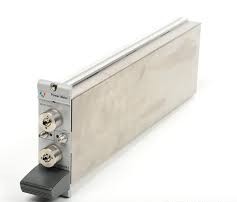
The 3626 BTF form factor packages the EDFA core for test and measurement environments. Fiber optic interfacing is standard. Operating specifications remain consistent across the stated wavelength range, enabling integration into existing C-band optical architectures without additional conditioning stages.






Reviews
There are no reviews yet.