

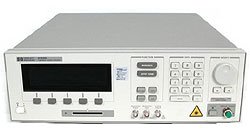
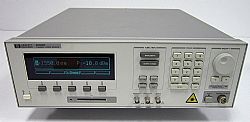
The Photonetics 4642HEL is a tunable external cavity laser engineered for precision fiber optic testing and measurement across telecommunications, research, and development applications. Built on the patented TUNICS cavity design with a dihedral rear reflector and Invar optical head construction, it delivers stable, mode-hop-free operation with exceptional wavelength accuracy and repeatable tuning performance across an extended spectral range.
– Technical Specifications
Tuning Performance
• Absolute wavelength accuracy: ±0.04 nm
• Tuning repeatability: ±0.005 nm (typical)
• Scan speed: 1 to 100 nm/s (adjustable)
• Power flatness during scan: ±0.25 dB (typical)
• Mode-hop-free range: Guaranteed 40 nm; actively controlled across full tuning range
• Wavelength resolution: 1 pm (optional) or 10 pm
Optical Performance
• Output power: 0 dBm (standard); +6 dBm and +10 dBm options available
• Power stability: ±0.01 dB (typical); ±0.01 dB/h or ±0.01 dB/24 h (typical)
• Side mode suppression ratio: >45 dB
• Relative intensity noise: >145 dB/Hz (typical)
• Optical connector: FC/APC
Electrical & Environmental
• Power supply: 100 to 240 V, 50 to 60 Hz
• Laser classification: Class IIIb (21 CFR Subchapter J)
• Warm-up time: Specifications after 30 minutes or 2 hours warm-up
– Key Features
• Patented TUNICS cavity with self-aligning dihedral rear reflector design
• Invar optical head eliminates thermal expansion—no temperature control required
• Full amplitude modulation and mode-locked operation capabilities
• External intensity modulation: 10 kHz to 1 GHz
• Wavelength meter compatible via RS 232-C remote control
• Lateral retractable handles for horizontal carrying
• Requires 15 mm minimum clearance for rear fan ventilation when rack-mounted
– Typical Applications
Optical signal transmission verification, fiber optic system characterization, telecommunications network testing, spectroscopic measurement, and research-level optical system development.
– Compatibility & Integration
Wavelength meter integration via RS 232-C control for automated wavelength adjustment. Modulation input accepts external signals for intensity control across 10 kHz to 1 GHz range.




Reviews
There are no reviews yet.