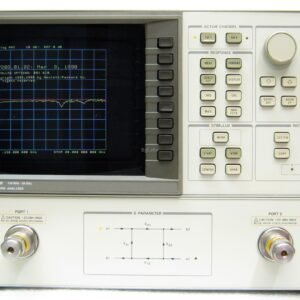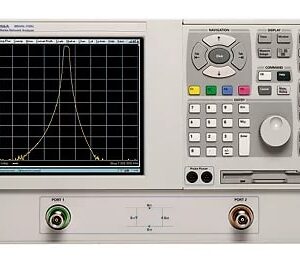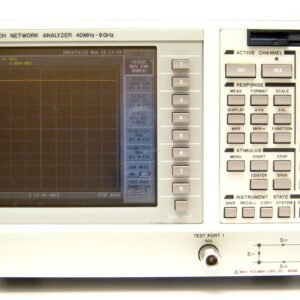

The Rohde & Schwarz ZVA67 is a vector network analyzer operating from 10 MHz to 67 GHz, designed for characterization of active and passive microwave components across aerospace, defense, telecommunications, and research applications. Available in 2- and 4-port configurations, it delivers dynamic range exceeding 140 dB at lower frequencies and 110 dB at 67 GHz. Output power reaches 18 dBm maximum with 6 dBm available at 67 GHz, supported by a 40 dB power sweep range. Measurement speed reaches sub-3.5 µs per test point, with frequency sweeps over 200 points completed in under 5 ms. IF bandwidth spans 1 Hz to 1 MHz in discrete steps, with optional 15 MHz (30 MHz for pulse profiles) capability. The analyzer supports up to 60,001 measurement points at 1 Hz frequency resolution and accommodates 20 traces per diagram with integrated trace mathematics including equation editing and statistical functions. Pulse profile measurements deliver 12.5 ns resolution. Frequency extension to 70 GHz overrange and millimeterwave converter compatibility to 325 GHz are available. All ports use 1.85 mm Male connectors with 50Ω impedance.
– Technical Specifications
• Frequency Range: 10 MHz to 67 GHz (70 GHz overrange; up to 325 GHz with millimeterwave converters)
• Port Configurations: 2- and 4-port models
• Dynamic Range: >140 dB (10 MHz to mid-band); 110 dB at 67 GHz; optional measurement input >145 dB (100 MHz to 24 GHz)
• Output Power: 18 dBm maximum; 6 dBm at 67 GHz; nominal –10 dBm; 40 dB sweep range
• Measurement Speed: <3.5 µs per test point; <5 ms for 200-point frequency sweep
• IF Bandwidth: 1 Hz to 1 MHz (discrete steps); optional 15 MHz (30 MHz pulse profiles)
• Pulse Profile Resolution: 12.5 ns
• Measurement Points: 1 to 60,001
• Frequency Resolution: 1 Hz
• Trace Capacity: 20 per diagram area
• Connector Type: 1.85 mm Male
• Impedance: 50Ω
– Key Features
• Trace mathematics with equation editor for online computation and statistical evaluation
• Amplifier and mixer measurements
• Noise figure characterization
• Calibration support including TOSM methods
– Typical Applications
• Aerospace and defense component characterization
• Telecommunications system analysis
• Research and development of RF/microwave components
• Nonlinear device measurements