

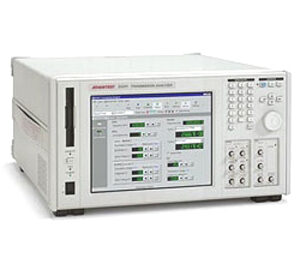
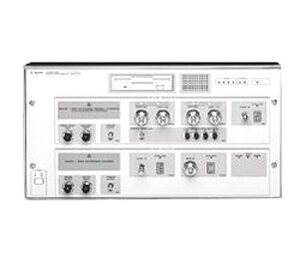
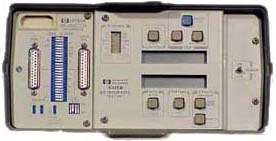
The Spirent DLS400IA2 is a Digital Subscriber Line test module engineered for comprehensive testing and analysis of DSL network performance across multiple standards. It simulates real-world local loop conditions using passive discrete component networks (L, R, C) to reproduce both AC and DC characteristics of telephony cables. The module delivers precise measurements essential for troubleshooting, network optimization, and validation of transmission schemes employing DMT, CAP, 2B1Q, and other line codes.
– Technical Specifications
DSL Standards Supported
• ADSL, ADSL2, ADSL2+, ADSL2++
• HDSL
• ISDN (BRI & PRI)
• SHDSL
• VDSL1, VDSL2
Line Simulation
• Accurate cable reproduction up to 1.5 MHz; select configurations extend to 2.0 MHz
• Supports ETSI ETR 328 and ANSI T1.413 Annex H cable types: 0.32 mm, 0.4 mm, 0.5 mm, 0.63 mm, and 0.9 mm
• 28 preset ADSL test loops with user-customizable configurations
• Hundreds of cable simulation segments matrixed for variable line lengths
• Micro Interruption simulation per G.shdsl standard
Noise and Impairment Generation
• White Gaussian noise (AWGN): -90 dBm/Hz to -140 dBm/Hz adjustable in 0.25 dB increments; alternate range -85.0 to -140.0 dBm/Hz in 0.1 dB steps. Bandwidth: 50 Hz to 2.0 MHz. Gaussian amplitude distribution to 5 sigma.
• Shaped noise: ETSI, ISDN, ETSI HDSL, or FTZ 1TR 220 profiles; 10.0 to +20.0 dB relative to reference
• 10-Tone generation (ETSI ETR 328): -20.0 to +20.0 dB relative to reference
• Impulse noise: 7 types including multi-level (unipolar ±, bipolar, 3-level), ANSI T1.413 Annex C complex, and ETSI Cook pulse. Duration: 20 to 120 microseconds in 1-microsecond steps.
• Dual-tone generation per ANSI T1.601
– Key Features
• Passive component networks eliminate active distortion in cable simulation
• Comprehensive impairment toolset for operational margin determination
• Flexible architecture supports user-defined test loops and cable configurations
– Compatibility & Integration
• IEEE-488 (GPIB) interface conforming to SCPI specifications
• RS-232 (DCE) serial interface: 9600 bps, no parity, 8 data bits, 1 stop bit, RTS/CTS handshake









Reviews
There are no reviews yet.