
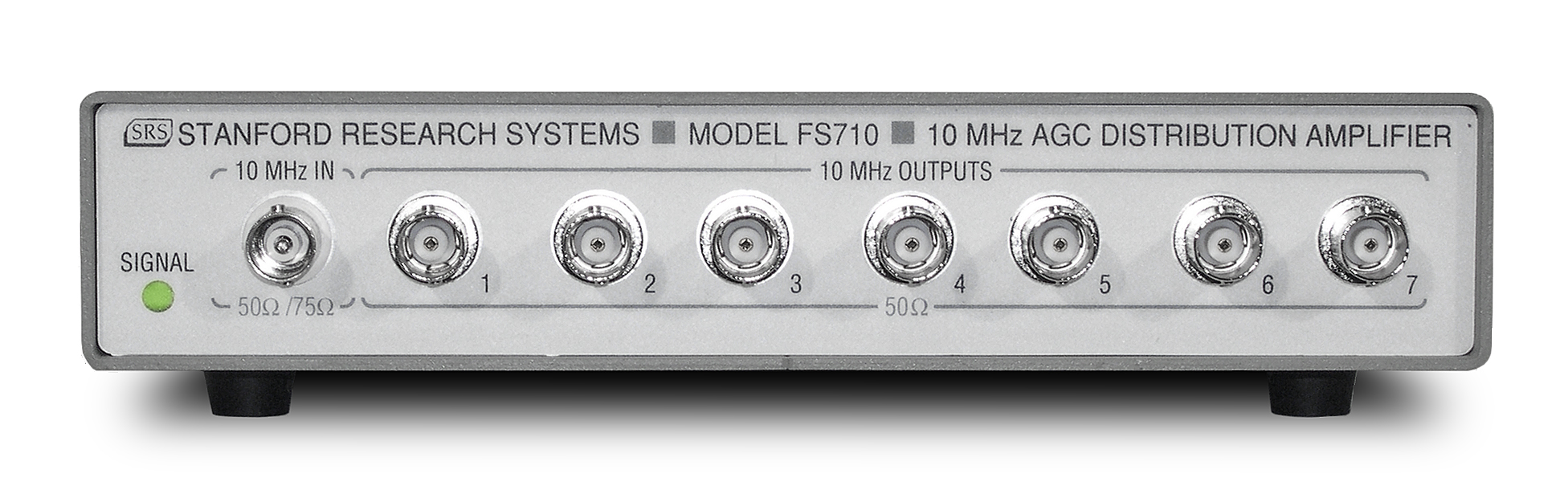

The Stanford Research FS710 is a 10 MHz AGC distribution amplifier that accepts a single 10 MHz reference input and delivers seven independently buffered outputs, each capable of driving extended cable runs. Built-in automatic gain control compensates for signal loss and maintains output amplitude consistency across all channels, supporting cable lengths up to one mile. The unit accepts input signals from 35 mV to 5 VAC peak-to-peak and delivers stable 1 Vpp (into 50 Ω) or 2 Vpp (into 10 kΩ) outputs with up to 30 dB of AGC gain.
– Technical Specifications
Input
• Frequency: 10 MHz ± 100 kHz
• Connector: Insulated BNC, transformer coupled
• Impedance: 50 Ω or 75 Ω (jumper selectable)
• Signal Level: 35 mV to 5 VAC peak-to-peak
• VSWR: <1.2 at 10 MHz
Output
• Seven local grounded BNC connectors
• Output Levels: 1 Vpp into 50 Ω (±10%) or 2 Vpp into 10 kΩ (±10%)
• Output VSWR: <1.2 at 10 MHz (50 Ω load)
• Distortion: <-25 dBc
• AGC Gain: Up to 30 dB
• Cable Drive Capability: One mile maximum
Power & Physical
• Input: 100/120/220/240 VAC, 50/60 Hz
• Power Consumption: 3 W
• Dimensions (WHD): 7.75" × 2" × 7.5"
• Weight: 3 lbs
– Key Features
• AGC circuit maintains constant output amplitude despite input level variations
• Seven independent output channels for multi-instrument distribution
• Selectable 50 Ω / 75 Ω input impedance
• Compact benchtop form factor
• Low distortion performance
– Typical Applications
• Frequency reference distribution in calibration laboratories
• Multi-channel timing signal distribution across test racks
• Extended-range cable distribution without signal degradation
– Compatibility & Integration
The FS710 accepts standard 10 MHz references and outputs BNC-terminated signals compatible with instruments requiring 10 MHz timing references or external frequency standards.








Reviews
There are no reviews yet.