
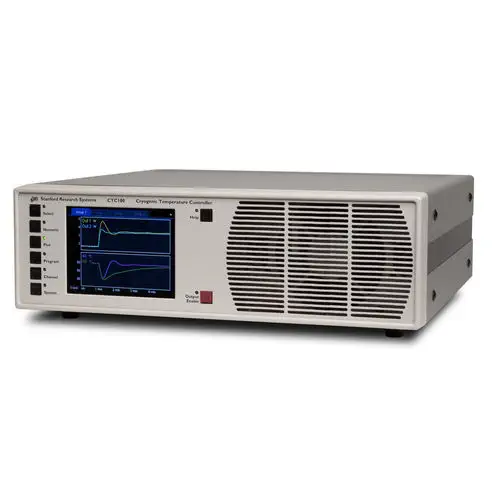

The Stanford Research Systems PTC10 Programmable Temperature Controller delivers precision temperature measurement, heater control, and data logging across laboratory and industrial applications. Its modular architecture accommodates up to four I/O cards, supporting configurations from single-channel monitoring to 16-input multi-point systems with up to 6 independent PID feedback control loops operating at 50 Hz. Temperature resolution reaches 1 mK, with custom calibration curves accepting up to 200 points loaded via USB. Data logs to removable flash media in binary format, convertible to ASCII using included software. Four configurable 24-bit analog I/O channels (±10 V input/16-bit output), eight bidirectional digital lines, and four relay outputs provide flexible hardware integration. Alarming functions enforce upper/lower limits and rate-of-change thresholds per input channel, triggering audible alerts and relay state changes. Advanced macro programming enables task automation, cascade feedback implementation, and behavioral customization. Three virtual channels support macro variable plotting, logging, and feedback input. Standard interfaces include USB, Ethernet, and RS-232; optional GPIB (IEEE 488.2) available. Power input accepts 10 A at 88–132 VAC or 176–264 VAC, 47–63 Hz, or DC. Physical footprint: 17″ W × 5″ H × 18″ D; 25 lbs.
– Technical Specifications
• PID control channels: Up to 6
• PID sampling rate: 50 Hz
• Temperature resolution: 1 mK
• Input channels: Up to 16 (card-dependent)
• Configurable analog I/O: Four channels, 24-bit ±10 V input or 16-bit ±10 V output
• Digital I/O: Eight bidirectional lines
• Relays: Four configurable outputs
• Custom calibration points: Up to 200 per curve
• Virtual channels: Up to 3
• Power: 10 A, 88–132 VAC or 176–264 VAC, 47–63 Hz, or DC
• Dimensions: 17″ W × 5″ H × 18″ D
• Weight: 25 lbs
– Key Features
• Modular I/O card system (up to 4 cards)
• Dual-voltage AC input and DC power option
• USB, Ethernet, RS-232 standard; optional GPIB
• Binary data logging to USB flash media
• Per-channel alarm limits with relay triggering
• Macro-based automation and custom feedback loops
• Thermistor, RTD, diode, and specialty sensor support
– Typical Applications
• Multi-point cryogenic and laboratory temperature monitoring
• Process control with feedback regulation
• Data acquisition and logging over extended runs
• Custom sensor integration via macro programming
– Compatibility & Integration
Communications via USB, Ethernet, RS-232, or optional GPIB enable integration into networked test environments and legacy instrument setups. Custom calibration curves and macro capabilities support non-standard sensor types and application-specific control logic.








Reviews
There are no reviews yet.