


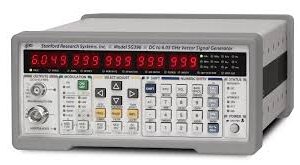
The Stanford Research Systems SG394 is a 4 GHz vector signal generator engineered for RF and microwave applications demanding precision synthesis, low phase noise, and flexible modulation. Built on Rational Approximation Frequency Synthesis (RAFS), the SG394 delivers spur-free outputs across 400 MHz to 4.05 GHz with 1 µHz frequency resolution and -116 dBc/Hz phase noise at 20 kHz offset (1 GHz). The instrument combines analog modulation (AM, FM, ΦM, pulse) with standard vector modulation supporting ASK, FSK, MSK, PSK, QAM, VSB, and custom I/Q schemes. Its dual 14-bit arbitrary waveform generators operate at 125 MS/s with symbol rates to 6 MHz, enabling modulation bandwidths of 300 MHz RF and analog modulation bandwidth exceeding 100 kHz. The baseband architecture includes raised cosine and root-raised cosine pulse shaping, Gaussian and user-defined FIR filters, and preset modes for GSM, EDGE, W-CDMA, APCO-25, DECT, NADC, PDC, ATSC-DTV, and TETRA. An ovenized SC-cut crystal oscillator (OCXO) timebase is standard; a rubidium oscillator option reduces aging and improves temperature stability. Vector modulation uses rear-panel I/Q inputs (±0.5 V, 50 Ω) with carrier suppression exceeding 40 dBc, while amplitude control spans +25 dB gain to -130 dB attenuation in 156 steps with 0.01 dB resolution. The SG394 accepts external 10 MHz timebase references and supports digital data playback with symbol constellation mapping, making it suitable for development, validation, and production testing across communication standards and custom waveform applications.
– Technical Specifications
• Frequency range: 400 MHz to 4.05 GHz (N-type output)
• Frequency resolution: 1 µHz
• BNC output (modulation): DC to 62.5 MHz
• SSB phase noise: -116 dBc/Hz at 20 kHz offset (1 GHz)
• Carrier suppression: >40 dBc (>35 dBc above 4 GHz)
• I/Q input offset: 100 kHz
• Modulation bandwidth (vector): 300 MHz RF
• Baseband DAC: Dual 14-bit at 125 MS/s
• Reconstruction filter: 10 MHz, 3rd order Bessel LPF
• Symbol rates: Up to 6 MHz
• I/Q full scale input: (I² + Q²)^½ = 0.5 V
• Amplitude modulation range: 0 to 100%
• Amplitude modulation resolution: 0.1%
• AM distortion: <1% (fC < 62.5 MHz, fM = 1 kHz); 62.5 MHz, fM = 1 kHz)
• Amplitude control: +25 dB gain to -130 dB attenuation (156 steps)
• Amplitude resolution: 0.01 dB
– Key Features
• Rational Approximation Frequency Synthesis (RAFS) for spur-free outputs
• Standard OCXO timebase with optional rubidium oscillator (Option 04)
• External 10 MHz timebase reference input
• Dual arbitrary waveform generators with I and Q channels
• Pulse shaping: raised cosine, root-raised cosine, Gaussian, rectangular, triangular, user-defined FIR
• Modulation modes: AM, FM, ΦM, pulse, vector (ASK, FSK, MSK, PSK, QAM, VSB, custom I/Q)
• Preset modulation: GSM, EDGE, W-CDMA, APCO-25, DECT, NADC, PDC, ATSC-DTV, TETRA
• Internal modulation sources: sine, ramp, sawtooth, square, noise waveforms
• Digital data playback with symbol constellation mapping
– Typical Applications
• Communication standards validation and testing
• Custom waveform development and characterization
• Receiver and transceiver bench testing
• Production test and alignment
– Compatibility & Integration
• N-type RF output connector
• Rear-panel BNC modulation inputs (external AM, FM, ΦM, pulse)
• Rear-panel I/Q inputs (±0.5 V, 50 Ω)
• External timebase reference: 10 MHz input (rear panel)






Reviews
There are no reviews yet.