
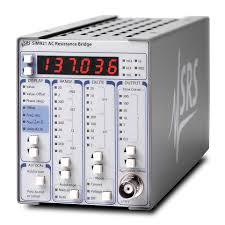

The Stanford Research Systems SIM921 is a precision AC resistance bridge module engineered for cryogenic thermometry with ultra-low excitation power. Operating as a 4-wire bridge with a single input channel, it measures resistances from 1 mΩ to 100 MΩ across a variable excitation frequency range of 2 Hz to 60 Hz. The instrument delivers excitation power below 100 aW, enabling accurate thermistor measurements at temperatures below 50 mK with negligible self-heating errors.
The SIM921 features a 32-bit demodulator with user-selectable time constants from 0.3 s to 300 s and a reading rate of 2 updates/s. Measurement accuracy within the 2 Ω to 200 kΩ range is ±(0.05% of reading + 0.05% of range), with input impedance exceeding 10 GΩ. Internal reference resistors span 1 Ω to 10 MΩ, supplemented by two expanded scales at 200 mΩ and 20 mΩ implemented via additional gain stages. Maximum permissible lead resistance is 100 Ω plus 25% of range.
The module supports both constant current and constant voltage excitation modes. Constant voltage operation reduces power dissipation in NTC thermistors as temperature decreases—essential for cryogenic applications. A linearized DC analog output provides voltage proportional to resistance or temperature with user-adjustable scale and offset parameters.
– Technical Specifications
• Measurement type: 4-wire AC bridge
• Resistance range: 1 mΩ to 100 MΩ
• Excitation frequency: 2 Hz to 60 Hz (variable)
• Excitation power: 10 GΩ (typical)
• Maximum lead resistance: 100 Ω + 25% of range
– Key Features
• Constant current and constant voltage excitation modes
• Linearized DC analog output with user-controlled scale and offset
• Support for up to four user-calibration curves (ohm to kelvin) with 200 data points each
• Double-wide SIM module format for SIM900 Mainframe integration
• Remote operation and data querying via computer interface
– Compatibility & Integration
The SIM921 operates with NTC sensors (germanium, Carbon-Glass, carbon-composition, Cernox, ruthenium oxide) and PTC sensors (rhodium-iron RTD, platinum RTD). Integration with the SIM900 Mainframe provides power, serial communications, and clock synchronization. For closed-loop temperature control, the module pairs with the SIM960 Analog PID Controller.





Reviews
There are no reviews yet.