


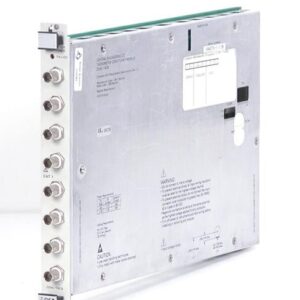
The Stanford Research SR552 is a BJT input voltage preamplifier that delivers gain at the point of measurement, minimizing noise and signal pickup in connecting cables. Designed for integration with Stanford Research Systems lock-in amplifiers, it reduces measurement time in noise-limited experiments and operates either through direct connection to compatible SRS instruments or independently with external power.
– Technical Specifications
Input Characteristics
• Input noise: 1.4 nV/√Hz at 1000 Hz, 1.6 nV/√Hz at 100 Hz, 2.5 nV/√Hz at 10 Hz
• Input impedance: 100 kΩ
• Input capacitance: 25 pF
• Maximum input: 70 mV RMS before overload
• Damage threshold: 20 VAC, 50 VDC
• Common mode rejection ratio: 100 dB at 100 Hz (1 V input)
• Common mode range: 1 V peak
Gain and Frequency Response
• Selectable gain: 10, 20, 50, or 100
• Gain accuracy: ±2% (2 Hz to 100 kHz)
• Gain stability: 200 ppm/°C
• AC coupling: 0.016 Hz to 100 kHz (frequencies below 1 Hz not detected)
• Maximum output: 10 V peak
Connections
• Input: Switch-selectable single-ended (A) or differential (A-B), BJT type
• Output (A): Single-ended, 600 Ω impedance
• Output (B): Shielded ground
• Power connector: 9-pin
– Key Features
• Automatic gain control via SR510 and SR530 lock-in amplifiers
• Fixed gain of 100 with DSP lock-ins and SR850/SR810/SR830 models (requires post-measurement division by 100)
• Powered via control cable from compatible SRS lock-in amplifiers or external supply (+20 VDC at 100 mA, +5 VDC at 10 mA, −20 VDC at 100 mA)
• Compact form factor: 1.3″ H × 3.0″ W × 5.1″ D, 1 lb
– Compatibility & Integration
Direct compatibility with SRS lock-in amplifiers: SR510, SR530, SR810, SR830, SR850, and SR124. When used with DSP lock-ins, gain compensation is not automatic—measurement data requires division by 100 to account for the fixed ×100 amplification.






Reviews
There are no reviews yet.