

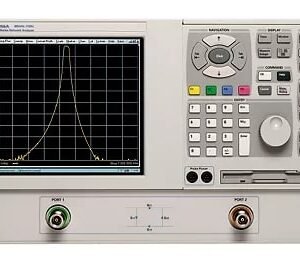
The Stanford Research SR770 is a single-channel FFT network analyzer that delivers high-performance frequency response analysis across electronic and mechanical systems. Operating from 476 µHz to 100 kHz with a real-time bandwidth of 100 kHz, it captures measurements with zero dead time, dramatically reducing analysis duration. The instrument combines a 16-bit ADC with dual 24-bit DSPs to process complex waveforms with 90 dB dynamic range, resolving signals to -114 dBc with averaging.
– Technical Specifications
Frequency and Resolution
• Measurement range: 476 µHz to 100 kHz
• Span range: 191 mHz to 100 kHz (binary sequence)
• Resolution bandwidth: Span/400
• Center frequency: Selectable across 0 to 100 kHz
• Frequency accuracy: 25 ppm (20 °C to 40 °C)
Dynamic Range and Amplitude
• Dynamic range: 90 dB (typical)
• Full-scale input: -60 dBV to +34 dBV in 2 dB steps
• Harmonic distortion: ≤ -80 dB (DC to 100 kHz at 0 dBV input)
• Spurious responses: ≤ -85 dB below full scale (<200 Hz); ≤ -90 dB below full scale to 100 kHz
• Noise floor: 5 nVrms/√Hz typical at 1 kHz; 10 nVrms/√Hz maximum
• Amplitude accuracy: ±0.3 dB ± 0.02 % of full scale
Processing
• Input sampling rate: 256 kHz
• Window functions: Hanning, Flat-Top, Uniform, Blackman-Harris
• Measurement modes: Spectrum, PSD, Time Record, 1/3 Octave, Harmonic, Band, and Sideband analysis
• Harmonic markers: Up to 400 harmonics
• Limit tables: 100 user-defined upper/lower trace segments
Internal Signal Source
• Type: Direct Digital Synthesis (DDS), low-distortion
• Output level: 100 µV to 1 V
• Output current: Up to 50 mA
• Signal types: Single sine, two-tone (IMD), pink noise, white noise, frequency chirp
• Synchronization: Phase-locked to input for transfer function measurements
– Key Features
• Menu-driven interface with context-sensitive help
• Span/400 resolution bandwidth for high spectral fidelity
• Dual 24-bit DSPs for efficient data processing
• Real-time 100 kHz bandwidth eliminates measurement gaps
• Pre-trigger capability up to 51.953 ms with 3.9062 ms delay resolution
– Typical Applications
Frequency response characterization, harmonic distortion measurement, two-tone intermodulation testing, mechanical vibration analysis, and transfer function determination.





Reviews
There are no reviews yet.