

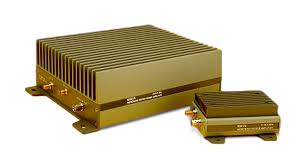
The Stanford Research Systems SR445 is a four-channel DC-coupled preamplifier engineered for high-performance signal amplification from DC to 300 MHz. Each channel delivers 5 V/V gain with the option to cascade up to three channels for total gains of 25 or 125. The unit excels at amplifying weak signals from fast photomultiplier tubes and photodiodes, making it ideal for integration with oscilloscopes, spectrum analyzers, and photon counters.
– Technical Specifications
• Channels: 4 independent
• Bandwidth: DC to 300 MHz (−3 dB)
• Voltage Gain: 5 per channel; up to 25 or 125 with cascaded channels
• Input Impedance: 50 Ω (all channels); 500 Ω selectable on Channel 1
• Output Impedance: 50 Ω DC coupled
• Input Voltage Range: ±200 mV
• Output Voltage Range: ±1.0 V
• Noise: <50 µVrms (input-referenced); 2.8 nV/√Hz
• Input Offset: ±50 µV adjustable
• Stability: 10 µV/°C (0 to 50 °C)
• Propagation Delay: 2.2 ns per channel
• Rise/Fall Time: 1.2 ns (single channel)
• Overload Recovery: <4 ns for 20× overload
• Input Protection: ±3.5 VDC, ±50 V transient
• Dimensions: 7.7" × 2" × 6.7" (W × H × D)
• Power Consumption: 16 W
• Power Requirements: 100/120/220/240 VAC, 50/60 Hz
– Key Features
• Sub-nanosecond rise/fall time ensures fast signal response
• Low input-referenced noise below 50 µVrms supports precision measurements
• Cascadable architecture allows flexible gain configuration
• Adjustable input offset accommodates DC component elimination
• Fast overload recovery enables continuous operation in high-dynamic-range environments
• Selectable 500 Ω input on Channel 1 for impedance matching
– Typical Applications
• Photomultiplier tube signal conditioning
• Photodiode preamplification
• Oscilloscope sensitivity enhancement
• Spectrum analyzer front-end amplification
• Photon counting systems
• Weak-signal detection in optical and particle physics experiments
– Compatibility & Integration
BNC connectors on all inputs and outputs enable straightforward integration into standard laboratory setups. The 50 Ω output impedance matches typical test equipment inputs. Power operates on standard 50/60 Hz mains voltage.








Reviews
There are no reviews yet.