

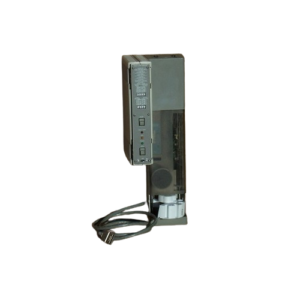
The Stanford Research Systems SR530 is a dual-phase lock-in amplifier for precision measurement of low-level AC signals in noisy environments. Operating from 0.5 Hz to 100 kHz, it delivers exceptional sensitivity down to 100 nV full-scale with input noise as low as 7 nV/√Hz at 1 kHz. The instrument employs sine-wave multiplier demodulation to eliminate spurious harmonics inherent in digital or square-wave designs, making it ideal for applications demanding accurate small-signal detection.
– Technical Specifications
Signal Detection
• Frequency range: 0.5 Hz to 100 kHz
• Input noise voltage: 7 nV/√Hz at 1 kHz (typical)
• Input noise current: 0.13 pA/√Hz at 1 kHz (typical)
• Full-scale sensitivities: 500 mV to 100 nV
• Dynamic reserve: Up to 80 dB (LOW 20 dB, NORM 40 dB, HIGH 60 dB; band-pass filter adds 20 dB)
• Accuracy: 5 ppm/°C (LOW sensitivity), 50 ppm/°C (NORM sensitivity)
Input Configuration
• Differential voltage input with 100 MΩ impedance
• Current input: 10⁶ V/A gain, 1 kΩ impedance to virtual ground
• Line notch filter: 50 dB rejection (45–65 Hz adjustable)
• Second harmonic notch: 50 dB rejection (100–130 Hz adjustable)
• Tracking band-pass filter: Q = 5, auto-tracks reference frequency
Filtering & Time Constants
• Two-stage filtering with selectable time constants from 1 msec to 100 seconds
• Rolloff: 6 dB/octave or 12 dB/octave
Reference & Oscillator
• Reference input accepts sine waves or pulsed edges
• Detection at fundamental and second harmonic of reference
• Internal oscillator (optional): 1 Hz to 100 kHz, voltage-controlled, 0.01/0.1/1 Vrms output, 20 mA drive capability
• Phase control: 0.025° resolution front-panel adjustment or ±90° increments
• Auto-phase measurement with single key-press
• Reference frequency display: 4-digit resolution
Output Options
• X and Y quadrature outputs (Rcosθ, Rsinθ)
• Four phase-shifted quadrant outputs (0°, 90°, 180°, 270°) at 1 Vrms
• Dual DAC outputs
• Signal monitor output
– Key Features
• Sine-wave multiplier demodulation eliminates harmonic artifacts
• Configurable dynamic reserve for adaptation to signal conditions
• Dual notch filters suppress line interference and harmonics
• High input impedance (100 MΩ) suitable for high-impedance sources
• Flexible reference input accepts multiple signal types
– Typical Applications
Precision measurement in noisy environments; low-level signal detection in research and industrial settings; phase-sensitive measurements in physical sciences; lock-in detection for modulated signal recovery.
– Compatibility & Integration
RS-232 interface for system control and data acquisition.





Reviews
There are no reviews yet.