

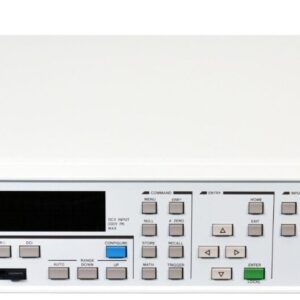
The Stanford Research Systems SR715 LCR Meter is a precision bench instrument for measuring inductance, capacitance, resistance, quality factor, and dissipation factor across component types and circuit assemblies. Built for incoming inspection, quality control, automated testing, and general laboratory measurement, the SR715 delivers 0.2% basic accuracy with a 5-digit LED display and flexible measurement modes including auto-ranging and manual selection. Its architecture supports both series and parallel equivalent circuit models, multiple triggering options, and direct integration with test automation systems via RS-232, GPIB, or handler interfaces.
– Technical Specifications
• Basic Accuracy: 0.2%
• Measurement Parameters: Inductance (L), Capacitance (C), Resistance (R), Quality Factor (Q), Dissipation Factor (D)
• Measurement Modes: Auto, R+Q, L+Q, C+D, C+R
• Display: 5-digit LED; shows value, deviation, % deviation, or bin number
• Equivalent Circuit Models: Series or Parallel
• Averaging: 2 to 10 measurements
• Measurement Rate: 2, 10, or 20 measurements/second (at 1 kHz and above); 0.6, 2.4, or 6 measurements/second (at 100 Hz and 120 Hz)
• Test Frequencies: 100 Hz, 120 Hz, 1 kHz, 10 kHz
• Frequency Accuracy: ±100 ppm
• Drive Voltage (Preset): 0.1 V, 0.25 V, 1.0 Vrms
• Drive Voltage (Vernier): 0.1 to 1.0 Vrms, 50 mV resolution
• Drive Level Accuracy: ±2%
• Internal Capacitor Bias: 2.0 VDC ±2%
• External Capacitor Bias: 0 to +40 VDC (0.25 A fused output)
• Power Consumption: 20 Watts
• AC Input: 100/120/220/240 VAC, 50 or 60 Hz
– Key Features
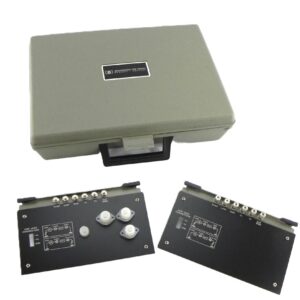
• 4-wire Kelvin fixture for radial leaded components with automatic null calibration
• Fixture protection rated to 1 Joule stored energy and 200 VDC
• Auto or manual ranging with continuous, manual, or remote triggering
• Included adapters for axial leaded parts; optional SMD tweezers, Kelvin clips, and BNC fixture adapter
– Typical Applications
Incoming component inspection, quality assurance testing, automated test environments, and general laboratory component characterization.
– Compatibility & Integration
RS-232 standard; GPIB (IEEE-488) and parts handler interface (DB25) available as options. Handler interface supports binning output and instrument status signaling.
Dimensions: 13.5″ W × 4″ H × 14″ L (343 × 102 × 356 mm)
Weight: 10 lbs (4.55 kg)






Reviews
There are no reviews yet.