

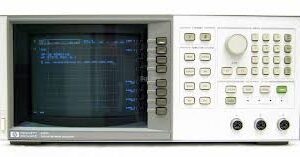
The Stanford Research Systems SR770 FFT Network Analyzer is a single-channel frequency response instrument delivering 90 dB typical dynamic range from 476 µHz to 100 kHz. It combines a synthesized internal source, real-time 100 kHz bandwidth, and dual-mode input (single-ended or true differential) to characterize systems across acoustics, vibration, noise measurement, and electronic engineering applications. The analyzer achieves ±25 ppm frequency accuracy and exceptionally low input noise—5 nVrms/√Hz typical at 1 kHz—enabling detection of signals as small as –114 dBc with averaging.
– Technical Specifications
Frequency Domain Analysis
• Measurement range: 476 µHz to 100 kHz
• Span range: 191 mHz to 100 kHz (binary sequence)
• Center frequency: Adjustable within measurement and span limits
• Frequency accuracy: ±25 ppm (20°C to 40°C)
• Resolution: Span/400
• Window functions: Blackman-Harris, Hanning, Flattop, Uniform
• Real-time bandwidth: 100 kHz
Signal Acquisition
• Input channels: 1
• Input impedance: 1 MΩ, 15 pF
• Coupling: AC or DC
• Input noise: 5 nVrms/√Hz typical (–166 dBVrms/√Hz); 10 nVrms/√Hz maximum (–160 dBVrms/√Hz)
• CMRR at 1 kHz: 90 dB (<–6 dBV), 80 dB (<14 dBV), 50 dB (≥14 dBV)
Performance Metrics
• Dynamic range: 90 dB typical
• Spurious responses: ≤–90 dBc (full-scale input)
• Minimum observable signal: –114 dBc with averaging
• Source harmonic distortion: –80 dBc
• Source flatness: <0.05 dBpk-pk typical; <0.2 dBpk-pk maximum
– Key Features
• Spectrum, power spectral density, time record, and 1/3 octave measurements
• Harmonic, band, and sideband analysis modes
• Total harmonic distortion (THD) and A-weighted octave measurements
• Trace math: addition, subtraction, multiplication, division, square root, logarithm
• Automated peak-find markers and delta-mode readouts
• Limit tables: up to 100 user-defined segments for GO/NO GO testing
• Data tables: 200-frequency display with automated harmonic/sideband entry
• Graphic expand: ×50 magnification capability
• Internal source: sine, two-tone, pink noise, white noise, frequency chirp
– Typical Applications
Acoustics, vibration analysis, noise characterization, transfer function measurement, intermodulation testing, and general electronic system characterization.
– Compatibility & Integration
Single-ended or true differential input configuration supports broad sensor and signal conditioning interfaces.









Reviews
There are no reviews yet.