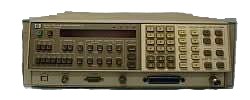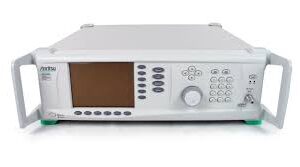

The Tektronix TG700 is a 1RU modular video signal generator platform that produces analog and digital video test signals across SD, HD, and 3G-SDI formats. Its four user-changeable generator module slots enable configuration for broadcast, research, development, and professional video applications. The platform delivers precise timing and amplitude control with long-term frequency stability of less than 1 ppm/year, referenced to an internal 13.5 MHz oscillator.
– Technical Specifications
Platform Architecture
• Form factor: 1RU rack mount
• Generator module slots: 4 (user-changeable)
• Power supply slots: 1
• Internal reference frequency: 13.5 MHz
• Long-term stability: <1 ppm/year
• Firmware versions: 4.3, 5.4, 5.5, 5.6
Digital Video Generator Modules
• HDVG7: Two identical 1.485 Gb/s SDI outputs; up to 16 channels of 20 or 24-bit audio at 48 kHz embedded
• HD3G7: 3 Gb/s serial video with two identical outputs; 20 or 24-bit audio at 48 kHz embedded
• HDLG7: Two identical dual-link HD-SDI outputs supporting 4:4:4 R'G'B' or 4:2:2 Y'C'bC'r up to 1080i/60 Hz or 1080p/60 Hz
Analog Video Generator Modules
• ATG7: Composite output with PAL, NTSC, NTSC No Setup support; one test signal, one color bar, two black outputs
• AVG7: Component, Y/C, and composite outputs; 525/625 interlace formats
• AWVG7: HD analog component (Y'P'bP'r or GBR); two identical outputs at 30 MHz bandwidth
Audio Generation
• AG7 module: Eight channels (four AES/EBU pairs); two silence channels (one AES/EBU pair); 48 kHz clock output
– Key Features
• Independent frequency and level control per audio channel
• Full frame and custom test pattern generation
• Embedded AV timing mode for synchronized audio/video
• Dual synchronization module support (GPS7, AGL7)
– Typical Applications
Broadcast equipment validation, video standard compliance testing, professional video system development, and research environments requiring multi-format signal generation.
– Compatibility & Integration
The modular architecture accepts DVG, HDVG, HD3G, analog video, audio, and synchronization modules in any operational combination within four available slots.