
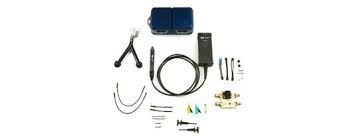

The Teledyne LeCroy ZD500 is a 500 MHz active differential probe engineered for precision measurement of high-speed differential signals in signal integrity, digital systems, automotive, serial data, and power testing applications. The probe delivers low noise performance with minimal circuit loading through exceptionally low input capacitance of 1.0 pF differential and high input impedance. Its ProBus interface integrates directly with compatible Teledyne LeCroy oscilloscopes, eliminating the need for external power supplies or batteries while enabling full front-panel control of gain, offset, and probe functions.
– Technical Specifications
• Bandwidth: 500 MHz warranted; 650 MHz typical
• Input Capacitance: 1.0 pF differential; 2 pF per side
• Input Resistance: 120 kΩ differential mode; 50 kΩ common mode
• Maximum Input Voltage: ±8 V
• Differential Range: ±8 V (16 Vp-p); 18 Vp-p typical
• Differential Offset Range: ±18 V nominal; ±8 V warranted
• Common Mode Range: ±10 V nominal; –10 V to 20 V typical
• Maximum Non-destructive Voltage: 30 V nominal
• Risetime: 650 ps (10–90%); 500 ps (20–80%)
• System Noise: 1.3 mV rms typical; 38 nV/√Hz noise density
• CMRR: 60 dB at 50/60 Hz; 30 dB at 20 MHz; 25 dB at 500 MHz
• Gain Accuracy: 2% LF attenuation; 2% offset gain typical
• Probe Offset: 5 mV typical (within 15 minutes post-autozero)
– Key Features
• Transparent probe attenuation with sensitivities from ×3 to ×12
• Auto Zero capability for DC offset drift correction
• Compact, low-mass probe head suited for dense circuit access
• 0.025 inch square pin probe tip socket
• Swivel Tip Adapter with Z-axis compliance; 0.300 inch tip spacing
– Typical Applications
• High-speed differential signal measurement
• Signal integrity analysis
• Serial data and power supply testing
• Automotive electronics characterization
– Compatibility & Integration
The ZD500 operates with Teledyne LeCroy oscilloscopes running MAUI firmware 6.4.1.x or later, including WaveSurfer, WaveRunner, WavePro, and WaveMaster series platforms. Power delivery and instrument control occur entirely through the ProBus interface.






Reviews
There are no reviews yet.