

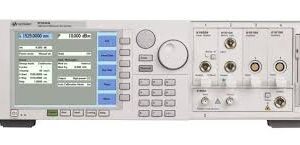
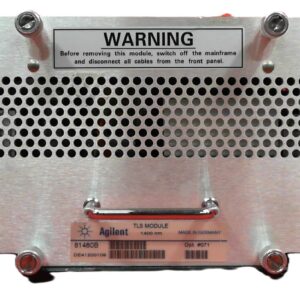
A tunable laser source is an optical instrument that emits light across an adjustable wavelength or frequency range, enabling precise spectral control for demanding measurement and communications applications. Dynamic wavelength tuning supports material characterization, high-resolution metrology, and efficient optical data transmission. Multiple tuning modes—continuous sweep, mode-hop-free, step tuning, and round-trip scanning—accommodate diverse experimental and production workflows.
– Technical Specifications
Wavelength Range:
Models cover standard telecom bands (T, O, E, S, C+L) or extended ranges from 210 nm to 10 µm. Select configurations provide continuous coverage from 1240 nm to 1650 nm with no gaps, or discrete C-band operation (1528.77 to 1563.86 nm / 191.7 to 196.1 THz). Custom ranges available upon request.
Spectral Performance:
Side Mode Suppression Ratio (SMSR) exceeds 40 dB, with premium models at 45 dB / 0.1 nm or 55 dB / 0.8 pm. Signal-to-Spontaneous Emission Ratio (SSE) typically >45 dB, extending to >55 dB in selected variants. Linewidth options range from 1 MHz typical to <100 kHz for high-stability applications, with sub-Hz resolution available in advanced configurations.
Accuracy & Stability:
Absolute wavelength accuracy of ±0.04 nm. Locked frequency accuracy ranges from -1.8 to 1.8 GHz. Wavelength stability maintains 5 pm / h (3 pm / h typical) and 5 pm / 24h. Tuning repeatability is ±0.005 nm typical with tuning resolution as fine as 0.001 nm or 0.01 pm (50 GHz frequency equivalent).
Tuning Performance:
Tuning speed varies from 20 ms for C-band step-tuning to 200 nm/s for swept modes and up to 20,000 nm/s for rapid wavelength scanning. Mode-hop-free tuning and optical frequency fine-tuning (±2 GHz) ensure stability across the operating range.
Output Power:
Power levels from 20 mW to +16.5 dBm (44.7 mW). Power stability ±0.01 dB / h with power ripple of 0.3 dB typical across the tuning range (0.5 dB maximum).
– Key Features
• Internal wavelength locker for precise ITU grid alignment in DWDM applications
• Multiple control interfaces: GPIB, Ethernet, RS-232, USB
• Remote operation via Ethernet connectivity
– Typical Applications
• Optical spectroscopy and material characterization
• High-resolution wavelength-dependent metrology
• DWDM telecommunications and channel testing
• Swept-wavelength measurement systems
– Compatibility & Integration
Integrated wavelength locking ensures reliable operation in dense wavelength division multiplexed systems. Standard laboratory and network control protocols enable direct integration into automated test environments.







Reviews
There are no reviews yet.