

RF Attenuators
Showing 181–192 of 192 results

Agilent/Keysight 8493B
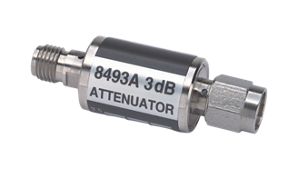
$69.00Agilent/Keysight 8493A
$69.00
Agilent/Keysight 8490G
$69.00Agilent/Keysight 84905M
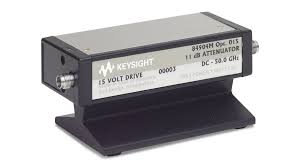
$3,119.00Agilent/Keysight 84904M
$2,789.00
Agilent/Keysight 478A
$1,250.00
Agilent/Keysight 410C
$1,250.00
Agilent/Keysight 355F
$0.00
Agilent/Keysight 11901C
$250.00Agilent/Keysight 11730A
$219.00Agilent/Keysight 11716D
$1,076.00Agilent/Keysight 11714A
$0.00







l RF attenuators maintain tight tolerance across their specified frequency range, ensuring that the actual signal reduction matches the nominal value. Inaccurate attenuation directly impacts power measurements, gain calculations, and system characterization.
Frequency response flatness determines how consistently the attenuator behaves across the band of operation. High-quality RF attenuators exhibit minimal variation, which is essential for broadband signals and swept-frequency measurements.
Power handling capability defines how much RF energy the attenuator can safely dissipate without thermal drift or failure. High-power RF attenuators are designed with proper heat sinking and internal construction to support continuous or pulsed operation.
VSWR and impedance stability are critical for preventing reflections and maintaining system accuracy. Precision RF attenuators are designed to maintain a stable 50-ohm environment even at high frequencies and power levels.
Repeatability and long-term stability are especially important in calibration and production environments. Attenuators used in these settings must deliver consistent performance over thousands of cycles and extended operating periods.
Types of RF Attenuators
Fixed RF attenuators provide a constant attenuation value and are commonly used for protection, matching, and baseline signal control. They are widely deployed in test benches, calibration chains, and permanent RF installations.
Step and variable RF attenuators allow adjustable attenuation levels, either manually or electronically. These are essential in applications requiring precise level control, dynamic range testing, and automated test systems.
Programmable and switched attenuators are often integrated into automated RF test setups, where repeatability and remote control are required. These attenuators are designed to maintain accuracy while switching between multiple attenuation states.
Construction and Technology
RF attenuators are built using carefully selected resistive elements and mechanical structures designed to minimize parasitic effects at high frequencies. Materials, layout, and internal geometry play a major role in determining frequency performance, power handling, and thermal behavior.
High-performance RF attenuators often incorporate robust housings, precision connectors, and internal designs that support stable operation under demanding conditions. Thermal management is especially important for high-power applications, where heat dissipation directly affects accuracy and reliability.
Where RF Attenuators Are Used
RF attenuators are used across wireless communications, aerospace and defense, semiconductor testing, and research laboratories. They are essential in radar systems, signal intelligence applications, transmitter testing, and receiver sensitivity measurements.
Calibration laboratories rely on RF attenuators to establish known signal levels and validate system accuracy. Their stability and traceability directly impact measurement confidence and compliance.
In production environments, attenuators are used to standardize test conditions, protect equipment, and ensure consistent product validation across large volumes.
Selecting the Right RF Attenuator
Choosing the correct RF attenuator involves evaluating frequency range, attenuation value, power handling requirements, and accuracy tolerance. Connector type, mechanical form factor, and environmental conditions must also be considered to ensure compatibility with existing systems.
At Aumictech, RF attenators are supplied with a focus on real-world RF performance, reliability, and practical integration. Whether used for protection, calibration, or precision signal control, the goal is dependable attenuation that performs exactly as expected in demanding RF environments.